

“Many decades ago, when I was 17, my mother sent me a profound book called “The Phenomenon of Man,” by Pierre Teilhard de Chardin. The text was written in the 1930s but was published only posthumously in 1955.
He was born on 1 May 1881 – passed 10 April 1955, Easter Sunday), and was a French Jesuit, Catholic priest, scientist, paleontologist, philosopher, mystic, and teacher.
Now, with many years having passed, I have returned to study about this astonishing priest and paleontologist. He was punished for his research and writings and exiled to China by the/his Jesuit Order from France. Unfortunately, none of his works could be published until after his death from a sudden heart attack. Soon after he passed away, his writings became instant bestsellers.
He kept on with his research even though his superiors regarded it as heretical, and he never gave in to despair. We need his noble life and his unwavering faith, and joy in learning how to move forward, no matter what is going on within our lives. If he were still here today, Teilhard Chardin would hold our hands and say, “Come walk with me into a new dawn where you shall experience hope and joy.”
So, occasionally, I will share more about this brilliant man and his literary works with you...🙏🙏📚
~Elizabeth
************
The Book “The Phenomenon of Man”
In 1955, with the English translation that followed in 1959.
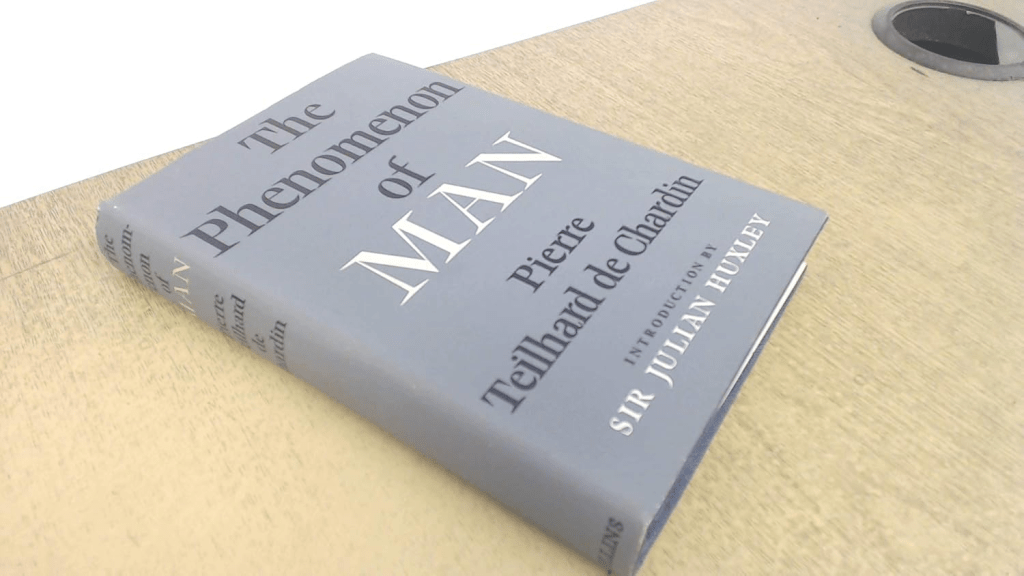
(A 1966 Reprint of ‘The Phenomenon of Man’)
ABOUT THE BOOK
(Courtesy of Wikipedia, the free encyclopedia)
The Phenomenon of Man (French: Le phénomène humain) is an essay by the French geologist, paleontologist, philosopher, and Jesuit priest Pierre Teilhard de Chardin. In this work, Teilhard describes evolution as a process that leads to increasing complexity, culminating in the unification of consciousness.
The text was written in the 1930s, but it was published only posthumously in 1955.
In depth, the work seeks to unify multiple scientific fields, as per the author’s multidisciplinary approach in his own career, with the principles of religion and broader human understandings of existence into a coherent whole. Centering upon biological evolution, Chardin articulates a vision of the universe itself as gradually increasing in complexity and unity from early chaos into ever greater oneness.
Drawing upon his devout Christianity, the author argues for a morally idealistic understanding of human nature through which social advancement under the watchful eye of God will eventually lead to a total reconciliation of all things and a final state of absolute collective consciousness, which Chardin titled the “Omega Point“. Thus, history’s final state will take place such that all of the creatures of the universe exist together with Jesus Christ as the “Logos” or sacred “Word”.
The book was initially published to scathing reviews by scientists. The Roman Catholic Church also distanced itself from Chardin’s viewpoints. However, more recent commentary by religious figures such as Pope Benedict XVI had been supportive. Positive reviews have also appeared in popular press outlets such as The New York Times…
Who Was Pierre Teilhard de Chardin
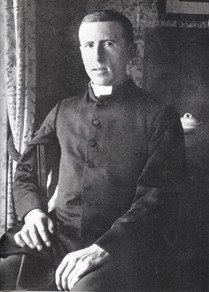
Pierre Teilhard de Chardin was a French Jesuit priest, paleontologist, and philosopher known for integrating evolution and spirituality. Born in 1881 in central France, he was deeply influenced by his religious upbringing and a fascination with natural history, leading him to pursue a vocation within the Jesuit order. Teilhard’s academic journey in science and theology shaped his unique perspective, where he viewed evolution not as a challenge to faith but as a framework for understanding spiritual development.
His work focused on the concept of cosmogenesis—the evolutionary process of the universe and its increasing complexity and consciousness. He introduced terms like “noosphere” to describe the sphere of human thought and “Omega Point” as the ultimate culmination of evolution towards a spiritual union with Christ. Throughout his career, particularly in China, he collected significant paleontological data while contemplating how scientific discoveries could enrich Christian theology.
Despite facing opposition from the Catholic Church regarding his views on Original Sin and evolution, Teilhard’s writings, including “The Phenomenon of Man,” proposed that humanity is at the spiritual center of the cosmos. His belief that the universe is evolving towards a greater spiritual reality resonates with many, making him significant in discussions about faith and science. Teilhard passed away in 1955, leaving behind a legacy of thought that continues to inspire dialogue between science and spirituality.
PRAYERS By Pierre Teilhard de Chardin
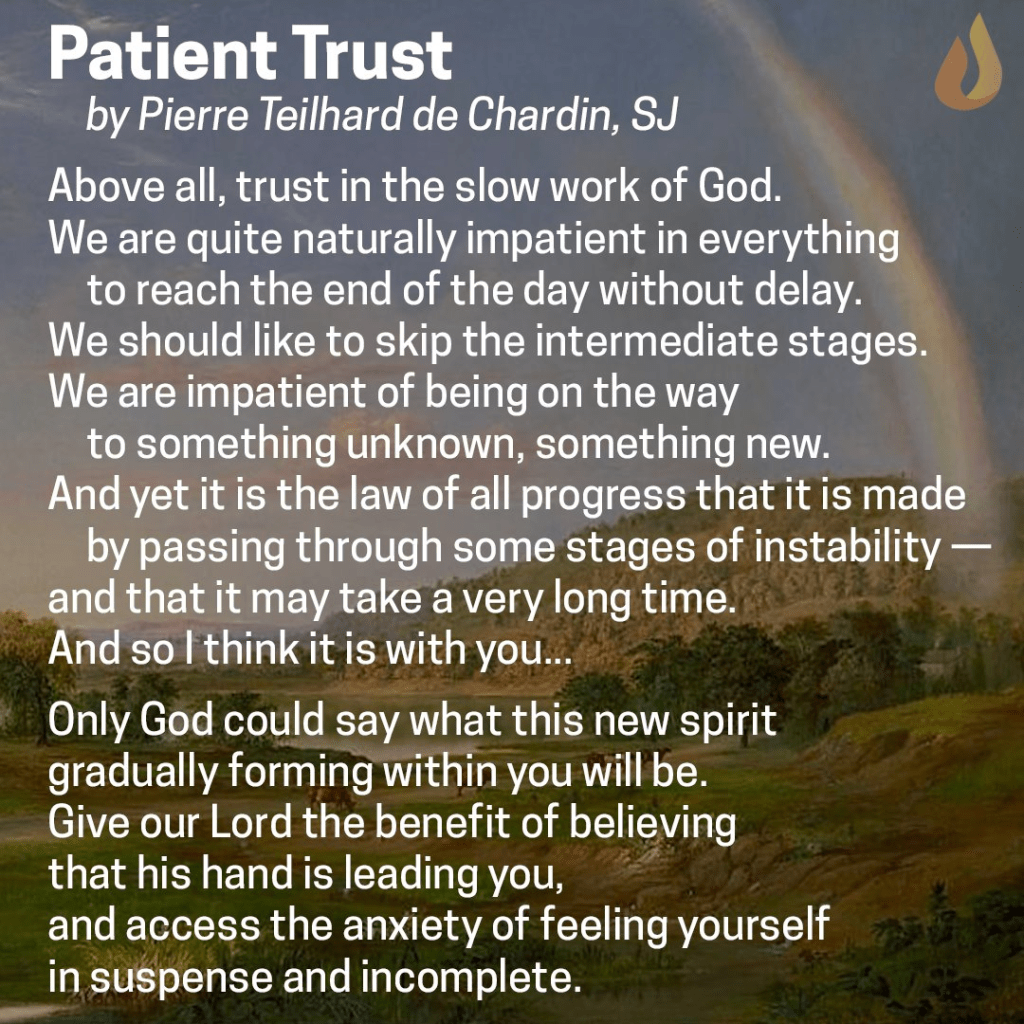
“Patient Trust”
************
Another Prayer – The Final Surrender
Lord, by every innate impulse and through all the hazards of my life,
I have been driven ceaselessly to search for you and to set you in the heart of the universe of matter.
Thus, I shall have the joy, when death comes,
of closing my eyes amidst the splendor of a universal transparency aglow with fire.
Under your influence and your alone, the sheath of organic isolation and willful egoism separating us into tiny individuals is rend asunder and dissolves.
The multitude of lives rush on towards that union which is necessary for the maturity of the world.
Only love can bring individual beings to their perfect completion, as individuals, by uniting them one with another, because only love takes possession of them and unites them by what lies deepest within them.
Lord, once again I ask: which is the more precious of these two beatitudes that all things are means through which I can touch you, or that you, yourself, are so ‘universal’ that I can experience you and lay hold on you in every creature?
Let us then establish ourselves in the divine milieu.
There we shall be within the depths of our being and the most remarkable consistency of matter.
There where all forms of beauty come together, we shall discover the ultra-vital, ultraperceptible, ultra-active point of the universe, and we shall also experience in the depths of our own being the fullness of our powers of action and of adoration – for this world is indeed full of ‘You O God.’
Let us leave the surface and plunge into God without leaving the world.
There and from there, in God and through God, we shall hold all things and find again the essence and splendor of all the flowers and lights, we have had to surrender here and now to be faithful to life.
**********


 Elizabeth Upton Award-Winning Author & Writer
You must be logged in to post a comment.